Yarn weight chart
Yarn is sorted by thickness into eight Craft Yarn Council categories, from 0 (lace) to 7 (jumbo). Each has a typical gauge and a range of hook and needle sizes. The UK and Australian names are the ones you'll see on labels and patterns there.
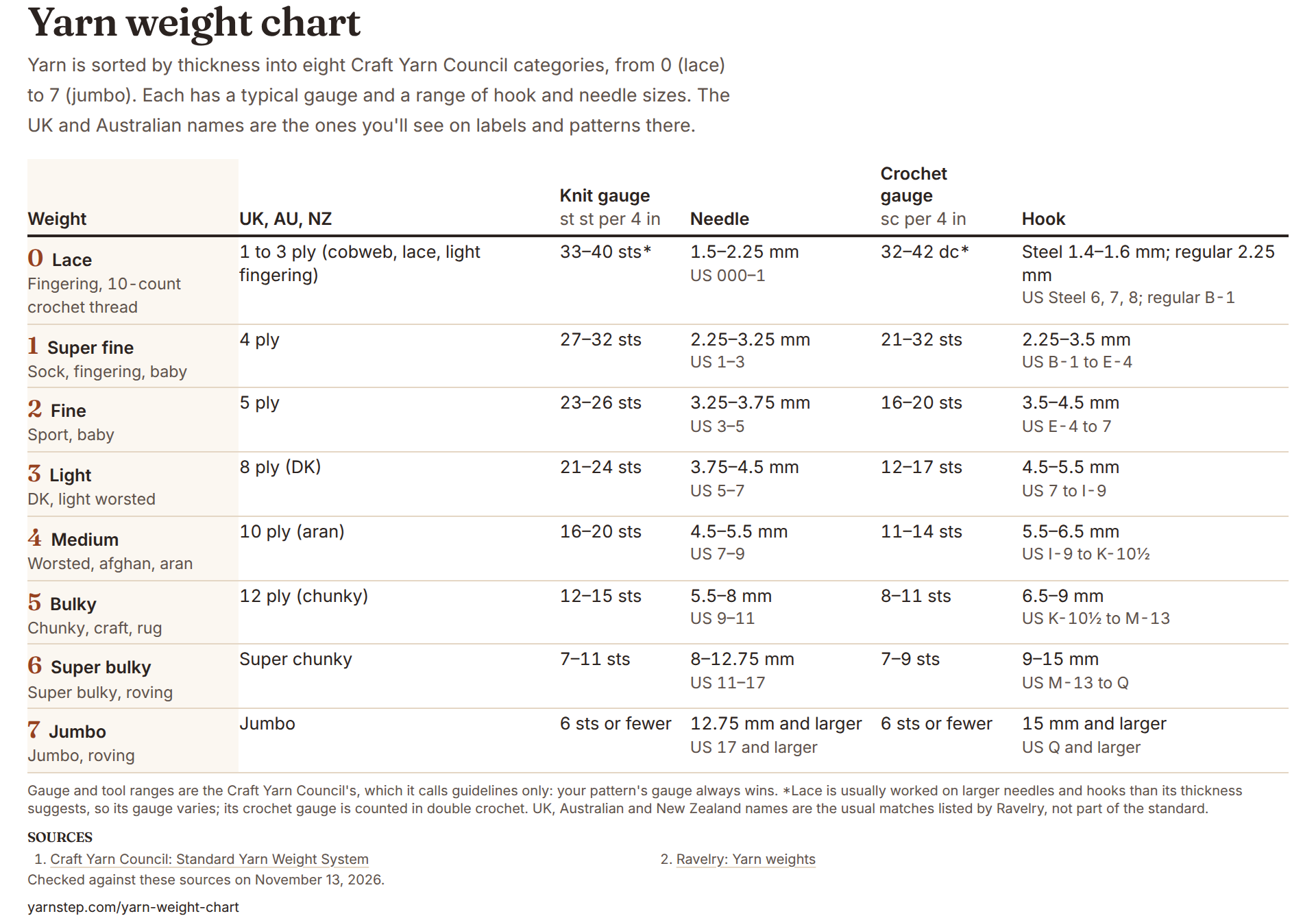
| Weight | UK, AU, NZ | Knit gaugest st per 4 in | Needle | Crochet gaugesc per 4 in | Hook |
|---|---|---|---|---|---|
| 0LaceFingering, 10-count crochet thread | 1 to 3 ply (cobweb, lace, light fingering) | 33–40 sts* | 1.5–2.25 mmUS 000–1 | 32–42 dc* | Steel 1.4–1.6 mm; regular 2.25 mmUS Steel 6, 7, 8; regular B-1 |
| 1Super fineSock, fingering, baby | 4 ply | 27–32 sts | 2.25–3.25 mmUS 1–3 | 21–32 sts | 2.25–3.5 mmUS B-1 to E-4 |
| 2FineSport, baby | 5 ply | 23–26 sts | 3.25–3.75 mmUS 3–5 | 16–20 sts | 3.5–4.5 mmUS E-4 to 7 |
| 3LightDK, light worsted | 8 ply (DK) | 21–24 sts | 3.75–4.5 mmUS 5–7 | 12–17 sts | 4.5–5.5 mmUS 7 to I-9 |
| 4MediumWorsted, afghan, aran | 10 ply (aran) | 16–20 sts | 4.5–5.5 mmUS 7–9 | 11–14 sts | 5.5–6.5 mmUS I-9 to K-10½ |
| 5BulkyChunky, craft, rug | 12 ply (chunky) | 12–15 sts | 5.5–8 mmUS 9–11 | 8–11 sts | 6.5–9 mmUS K-10½ to M-13 |
| 6Super bulkySuper bulky, roving | Super chunky | 7–11 sts | 8–12.75 mmUS 11–17 | 7–9 sts | 9–15 mmUS M-13 to Q |
| 7JumboJumbo, roving | Jumbo | 6 sts or fewer | 12.75 mm and largerUS 17 and larger | 6 sts or fewer | 15 mm and largerUS Q and larger |
Gauge and tool ranges are the Craft Yarn Council's, which it calls guidelines only: your pattern's gauge always wins. *Lace is usually worked on larger needles and hooks than its thickness suggests, so its gauge varies; its crochet gauge is counted in double crochet. UK, Australian and New Zealand names are the usual matches listed by Ravelry, not part of the standard.
Sources
Checked against these sources on .
Using the chart when a pattern names a yarn
Most patterns name a specific yarn, then give a gauge. A typical materials block:
Yarn: 5 skeins of a worsted weight wool (220 yds / 200 m per 100 g)
Needles: US 8 (5 mm)
Gauge: 18 sts and 24 rows = 4 in (10 cm) in stockinette, after blocking
- Find the category. Worsted is category 4, and 18 stitches per 4 inches sits inside its knit range of 16 to 20. Any medium yarn is a candidate.
- Check the needle. 5 mm is inside the 4.5 to 5.5 mm range for category 4. A needle far outside the range means the designer wanted a looser or firmer fabric than usual.
- Compare length per 100 g. A yarn with a similar yardage per 100 g usually behaves more like the original than one that only shares the word "worsted".
- Swatch. Work a square a little over 4 inches with your yarn and the suggested needle or hook, wash and dry it the way you'll treat the finished piece, then count.
- Change the tool, not the yarn. Too many stitches: go up a size. Too few: go down. Theneedle size chart and hook size chart give the next size each way.
UK and Australian patterns say tension for gauge. A UK line might read:
Tension: 22 sts and 28 rows to 10 cm over st st using 4mm needles
22 stitches per 10 cm points to DK, category 3, and "st st" is stocking stitch, which US patterns call stockinette.
Names that trip people up
DK and worsted are different weights. DK is one category thinner. A sweater knitted in DK from a worsted pattern, at the pattern's stitch counts, comes out noticeably smaller.
Aran and worsted share category 4. Aran is often the thicker of the two, so expect to go down a needle or hook size to match a worsted gauge.
"Ply" changes meaning by country. In the US it counts the strands twisted together. In the UK, Australia and New Zealand it is a weight name: 4 ply is a fine sock-weight yarn, 8 ply is DK and 10 ply is worsted or aran, however many strands they have.
Stitch names change too. A UK pattern shifts the crochet stitch names as well as the yarn names: UK double crochet is US single crochet. The abbreviation lookup gives both.
Guessing an unlabelled yarn
Wrap the yarn around a ruler without stretching it, strands touching, and count the wraps in one inch. Ravelry lists about 14 wraps per inch for fingering, 12 for sport, 11 for DK, 9 for worsted, 8 for aran, 7 for bulky and 5 to 6 for super bulky. Treat that as a first guess, then swatch on the middle needle or hook for the weight you suspect and compare it with the gauge columns above.
When the weight changes your size
Two yarns in the same category can still knit up at 16 and at 20 stitches per 4 inches. At 16, 160 stitches measure 40 inches. At 20, the same 160 measure 32. If your swatch won't match with any needle, divide your stitches per 4 inches by the pattern's and multiply each stitch count by the result, rounding to keep the pattern's stitch multiple. For yarn, multiply the pattern's skeins by the yards per skein, divide by the yards in one of yours and round up.
Yarn weight questions
Is DK the same as worsted?
No. DK is category 3 (light) and worsted is category 4 (medium). Worsted is thicker, so it knits up to fewer stitches per 4 inches. Yarns sold as "light worsted" sit in category 3 with DK.
What is 8 ply yarn in the US?
Australian and New Zealand 8 ply is DK, category 3 (light). In those countries ply names describe thickness, not the number of strands, so check the gauge on the label to be sure.
Is aran the same as worsted weight?
Both sit in category 4 (medium), and both are called 10 ply in Australia. Aran is often at the thicker end of the range, so with aran yarn a worsted pattern may need a slightly smaller needle or hook to match gauge.
What does the number on a yarn label mean?
It is the Craft Yarn Council weight category, printed inside a small skein symbol: 0 for lace up to 7 for jumbo. The label usually also gives a gauge and a needle or hook size, which are more exact than the category.
Can I use a different yarn weight than the pattern says?
Only if you change the stitch counts too. A thicker or thinner yarn changes the size of every stitch, so a garment comes out a different size. For a blanket or scarf the size change may not matter, but you will need a different amount of yarn.